
Information of the investigation
| Date of occurrence:
Date of notification and notifier: Date of decision to investigate: Date of the interim report: Date of completion: Occurrence national number: Occurrence severity: |
27.11.2025
27.11.2025 – Em. Response Centre 08.12.2025 – 27.11.2026 R271125 serious accident |
| Investigator in Charge: | Tarvi Viisalu |
| Reasons to investigate:
Under Section 50(2) of the Railways Act, initiating a safety investigation into a serious accident is mandatory. |
|
What happened?
Date and time of the event: 27 November 2025 at 09:15
Location of the event: Category II Saku-Soo passive level crossing, located at km 18.796 on the single-track section between Liiva and Kiisa stations on the railway infrastructure managed by Edelaraudtee AS. The level crossing is located within a built-up area. Geographical coordinates: N 59.289693° and E 24.666905°.
Type of event: Serious accident
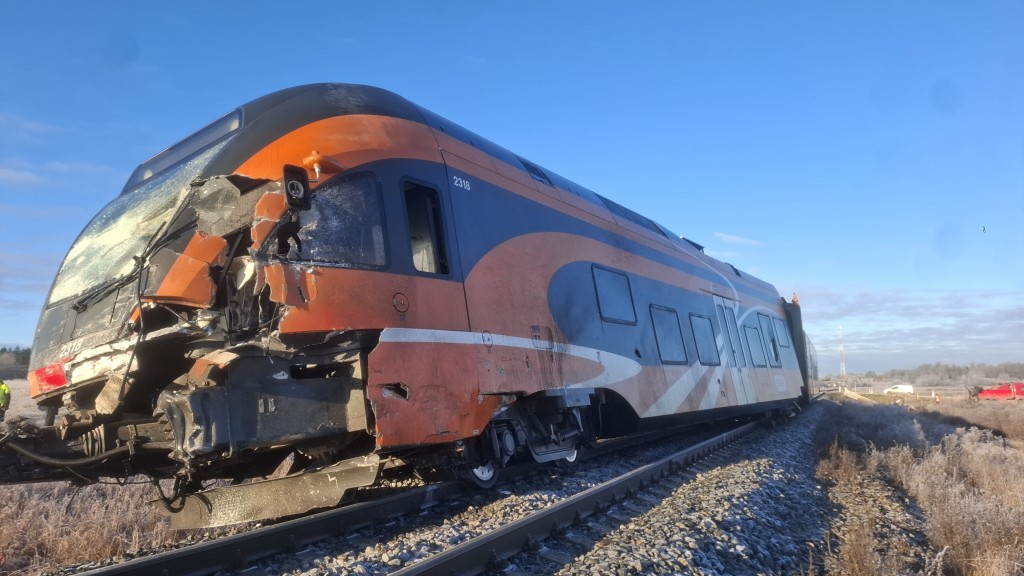
Event description: A three-car Stadler FLIRT diesel multiple unit (DMU) No. 2318, operated by AS Eesti Liinirongid (Elron) as passenger train No. 0323 on the Tallinn–Rapla route, collided with a Volvo tipper truck, registration number 300 MKS, owned by Vidoman OÜ, at the Saku-Soo passive level crossing on the section between Liiva and Kiisa stations.
Consequences of the event: As a result of the accident, the driver of the tipper truck was fatally injured. The train driver and two passengers sustained minor injuries. The leading car of the train derailed, rendering the train immobilised. The railway track superstructure and other infrastructure were damaged, and the section between Liiva and Kiisa stations was closed to rail traffic. The tipper truck sustained extensive damage.
Why it happened?
Causal factors: The causal factor of the accident was the tipper truck entering the Saku-Soo level crossing in front of an approaching passenger train when the train's distance from the crossing and its speed made it impossible for the train driver to avoid the collision.
Contributing factor: At the time of the accident, the Saku-Soo level crossing was a passive level crossing without automatic light signals or barriers. Although the level crossing complied with the applicable legal requirements, the absence of active warning devices meant that safe crossing depended to a considerable extent on the road user's attentiveness, timely detection of the approaching train and assessment of the traffic situation. The presence of additional technical safety measures could have reduced the likelihood of the accident occurring.
Systemic factors: The safety investigation examined the technical safety arrangements of the level crossing, the absence of active warning devices, and the safety management and risk mitigation arrangements of the undertakings concerned. Based on the evidence collected, no organisational, managerial or regulatory deficiencies were identified for which a causal or contributing link to the accident could be established. Nevertheless, the adequacy of technical safety measures at passive level crossings remains a broader safety issue that may affect the risk of similar accidents occurring in the future.
Other investigation findings: Weather and general visibility conditions were good at the time of the accident. Vegetation growing in the roadside ditch restricted the tipper truck driver's view of the railway during the earlier stage of approaching the level crossing. Visibility improved closer to the crossing, making it possible to detect the approaching train. The evidence collected did not allow a definitive determination of whether, and to what extent, the restricted visibility influenced the tipper truck driver's actions.
The safety investigation did not identify any technical failure of the rolling stock, railway infrastructure or tipper truck that was causally related to the accident. Furthermore, no evidence was found confirming that the tipper truck driver's medical condition or alcohol or drug intoxication contributed to the accident. The train driver sounded the horn and applied the emergency brake, but the collision could no longer be avoided.
What can be improved?
Based on the findings of the safety investigation and with the aim of preventing similar accidents, the Estonian Safety Investigation Bureau issued five safety recommendations to various stakeholders.
These recommendations primarily concern the further risk assessment of railway level crossings not equipped with automatic traffic light signalling or barriers, and the preparation of a risk-based action plan for implementing additional safety measures based on the assessment results.
It was also recommended that the safety of the Saku-Soo level crossing be reassessed, taking into account planned changes to the traffic environment, including the construction of a new pedestrian railway crossing and the expected increase in traffic associated with the establishment of the Rail Baltica Saku stop.
To support the risk assessment process, it was further recommended that an analysis be carried out of hazardous situations that have occurred at level crossings along the Tallinn–Lelle–Viljandi railway line over the past ten years. In addition, it was recommended that the Railway Technical Operating Rules be amended to require risk assessments for all publicly accessible railway level crossings and their periodic review, as well as their updating whenever significant changes occur in the traffic environment.

