
Information of the investigation
| Date of occurrence: Date of notification and notifier: Date of decision to investigate: Date of the interim report: Date of the safety investigation completion: Occurrence national number: Occurrence severity: |
21.07.2021 21.07.2021 – Transport Administration 28.07.2021 - 06.03.2025 M210721 less serious marine casualty |
| Reasons to investigate: to identify the causes of the accident in order to prevent similar incidents in the future |
|
What happened?
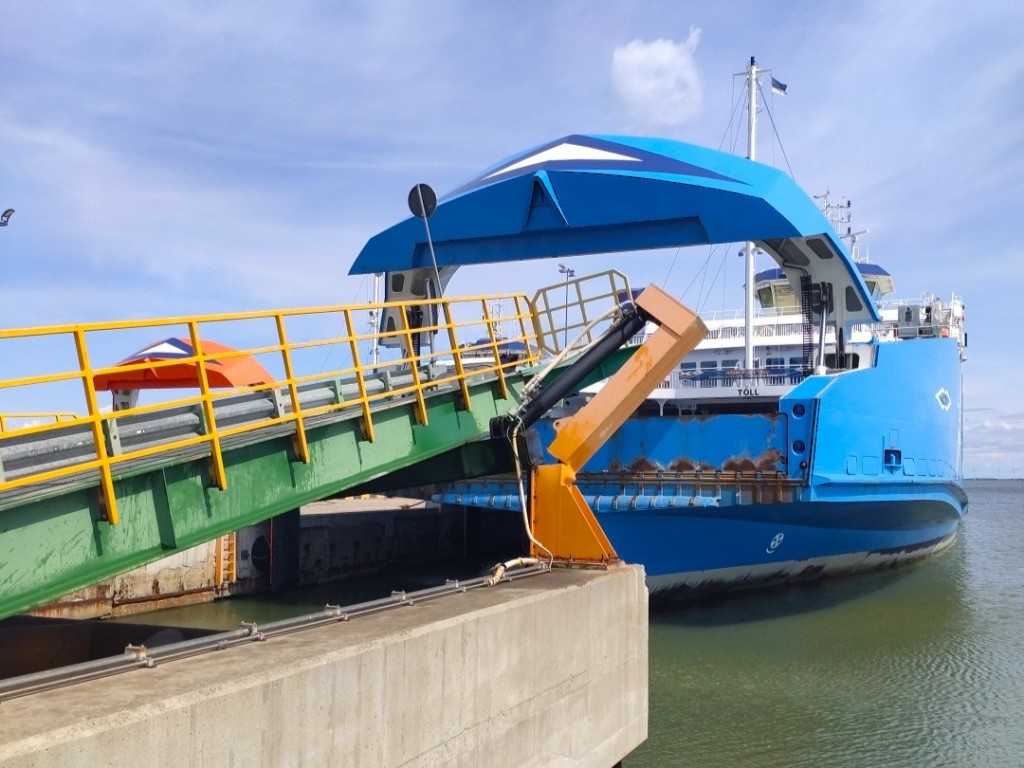
On July 21, 2021, the passenger ferry TÕLL headed from Virtsu to Kuivastu during a scheduled voyage. When mooring at berth No. 1, the vessel's hybrid energy system did not respond to the increased energy demand of the propulsion units. The hybrid system did not exit from the battery charging mode and did not direct the additional energy needed from the batteries to the propulsion units to increase the revolutions. As a result, the vessel's speed could not be reduced and at 14:28 the vessel collided with the shore ramp of berth No. 1.
Why it happened?
At the time of the marine casualty, the passenger ferry TÕLL was operating in hybrid energy mode and the electric generator load target value was set to 85%, which was needed to increase the vessel's speed to stay on schedule. Although the tender terms of the vessel's energy system conversion to a hybrid system described that the vessel's sea trials must demonstrate the capability of the hybrid system to operate the vessel with a single generator workload of 85%, in reality the permitted workload target value for the hybrid system installed on the vessel was up to 80%, but this was not stated in any document, and the vessel's officer of the navigational watch was still able to choose higher generator workload target values.
During mooring, while the propulsion unit revolutions were increased, the generator load exceeded the 87% limit. When the 87% limit was crossed, the black-out prevention system (B.O.S.S.) was activated to prevent a black-out, also the charging module (Quest) should have stopped charging the batteries if the generator load was higher than 87%. Since the B.O.S.S. system kept the engines in a power limit state (load below 87%), the Quest charging module's restriction to stop charging the batteries did not apply and the vessel's energy management system PMS in turn, tried to achieve the generator load target value of 85% again. The velocities of the hybrid system signals were not designed to operate within the narrow 2% hybrid settings range, as a result of which the system's various protection mechanisms suppressed the signals, this signal chain was looping and the correct signal did not reach the vessel's energy management system PMS to satisfy the propulsion system's need for additional energy from the vessel's batteries. To start additional generator, the generator's workload had to be above 90% for 10 seconds, which also did not happen when the protection systems were activated and system was in a power limitation situation.
What can be improved?
Shipowners, classification societies and shipbuilding companies are recommended to ensure that when converting energy systems of vessels:
- a thorough risk analysis is carried out during the design process for the safe interaction of the various energy systems of vessel and the necessary safety barriers are designed and implemented;
- conversions are carried out in accordance with the approved project documentation;
- thorough sea trial is carried out, during which the activation of the protection mechanisms of the various energy systems and the safe interaction of the energy systems at limit loads are tested;
- vessel crews are appropriately trained to understand the operating principles and limitations of the energy systems.

