
Information of the investigation
| Date of occurrence: Date of notification and notifier: Date of decision to investigate: Date of the interim report: Date of the safety investigation completion: Occurrence national number: Occurrence severity: |
17.12.2021 17.12.2021 – Transport Administration 12.01.2022 - 13.01.2025 M171221 serious marine casualty |
| Reasons to investigate: to identify the causes of the accident in order to prevent similar incidents in the future |
|
What happened?
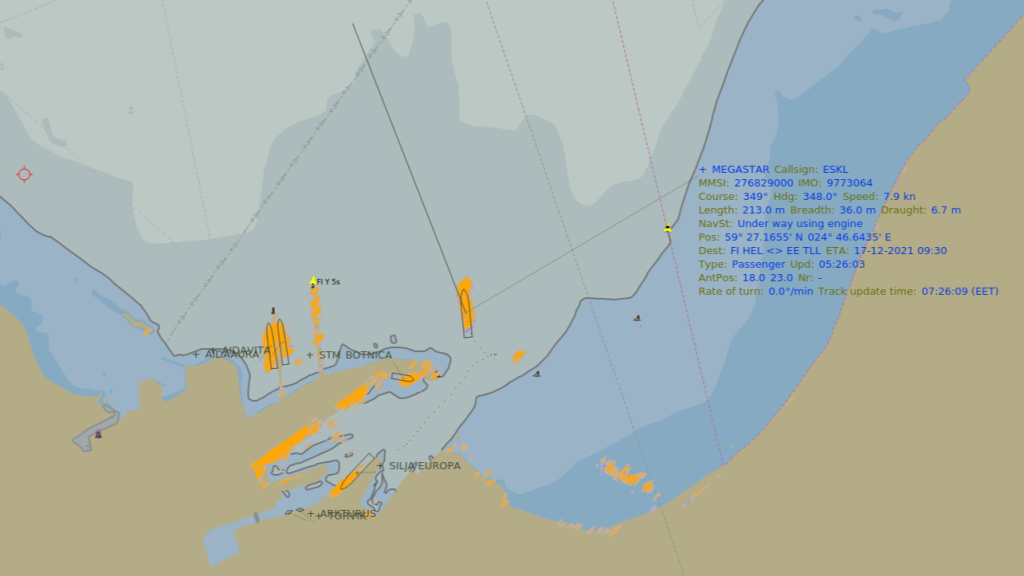
On December 17, 2021 at 07:15, the passenger ferry MEGASTAR (IMO No 9773064) departed from Tallinn (Vanasadam) to Port of Helsinki (West terminal 2) in Finland. After leaving the berth and turning around the vessel accelerated to 100% load, as a result of which the protection system of the propulsion electric motor was activated and at 07:25 the vessel's only operating propulsion electric motor shut down. The vessel lost propulsion 0.2 nautical miles north from the pier of the Vanasadam and master decided to move by inertia to anchor near anchorage area B. At 08:03, the MEGASTAR anchored at coordinates 59° 27.7’ N and 024° 45.5’ E, east from anchoring area B. The vessel’s crew was unable to fix the fault, so the MEGASTAR was towed back to the Vanasadam, where the vessel arrived at 11:00.
Why it happened?
The left propulsion electric motor shut down due to an unexpected voltage drop in the frequency converter, which triggered the frequency converter protection mechanism and caused the frequency converter shut down. The voltage drop was caused by a short circuit in the inverter unit due to the faulty power electronics components. On departure, the starboard propulsion electric motor of the MEGASTAR was not operational (since the last departure from Helsinki to Tallinn on December 16 at 22:33) and the vessel was proceeding with one propulsion electric motor. The vessel's essential systems, including the propulsion systems, must be available to ensure the vessel's ability to safely return to port after fire or flooding damage. Although this accident was a result of the technical failure, if the vessel had met the requirements for safe return to port, the shutdown of one of the propulsion electric motors would not have led to the loss of propulsion.
What can be improved?
OÜ HT Laevateenindus is recommended to analyse the list of systems specified in SOLAS convention chapter II-2 regulation 21.4 (including relevant IMO circulars) that shall be available after the fire damage to the vessel specified in SOLAS chapter II-1 regulation 8-1.2 and flooding damage specified in SOLAS chapter II-2 regulation 21.3 and provide clear guidelines to vessel masters with which system failures the vessel must not depart from the port.

