
Information of the investigation
| Date of occurrence: Date of notification and notifier: Date of decision to investigate: Date of the interim report: Date of the safety investigation completion: Occurrence national number: Occurrence severity: |
25 January 2025 25 January 2025 – AS Saarte Liinid 14 February 2025 – 7 April 2025 M250125 less serious marine casualty |
| Lead investigator: | Tauri Roosipuu Marine Casualty Senior Investigator |
| Reasons to investigate: to identify the causes of the accident in order to prevent similar accidents in the future, taking into account that:
|
|
What happened?
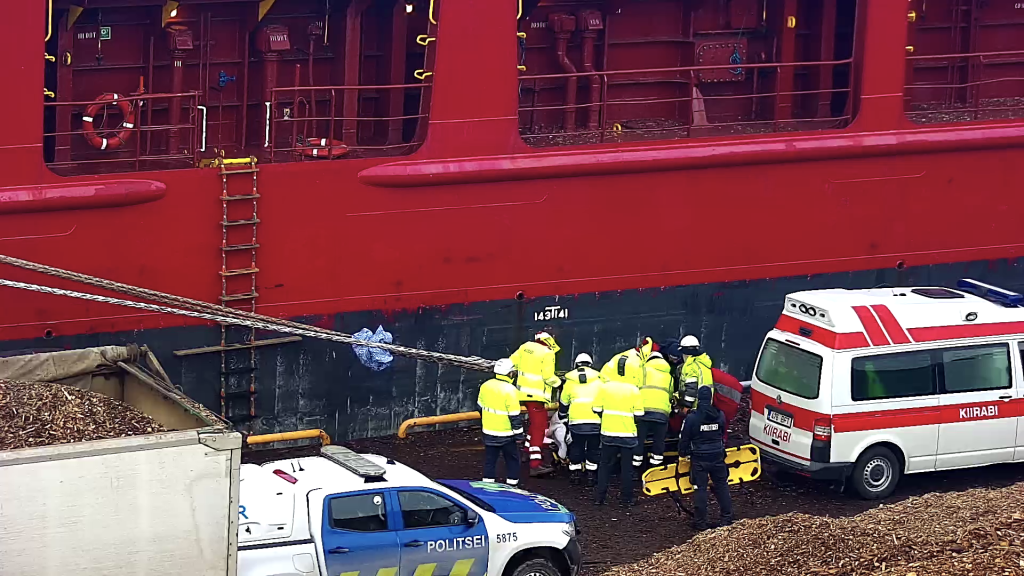
On 25 January 2025 at 00:20, the general cargo vessel DANITA arrived in ballast at Heltermaa harbour, where it was moored alongside berth No. 3 with starboard side. The vessel’s accommodation ladder on the poop deck was not placed on the berth, and a pilot ladder on the aft section of the vessel was used for embarkation. In the morning, loading of wood chips commenced by a mobile wheel crane, which operated in various locations on the berth during the day. At 12:00, the 2nd Officer and the deck cadet began the harbour watch. Before the accident, loading had been stopped because loading of a cargo vessel is not permitted due to dust etc. while the passenger ferry is in harbour. During the loading break, three crew members, including the deck cadet, disembarked to collect supplies, which had been delivered near the stern of the vessel. The mobile crane was located next to the pilot ladder, where it had stopped working before the loading break. While the crane operator was preparing to resume loading, a deck cadet walked from the rear of the crane towards the pilot ladder, escorting two police officers who had arrived to conduct a border check. During the first lift with the crane, the deck cadet reached the crane and the upper part of the pilot ladder. The crane then began to turn back towards the berth and at 14:33 the front end of the crane's left platform hit the deck cadet, who fell between the berth and the vessel and from there between the fenders into the water. With the help of police officers and crew members, the victim was rescued from the water, an ambulance was called, and first aid was given. After being taken to Hiiumaa Hospital, the victim was transported to the North Estonia Medical Centre. The victim had a fracture of the right femur, which required surgery at the regional hospital. On 26 January at 03:30, the general cargo vessel DANITA departed from Heltermaa for Skarbak.
Why it happened?
As a result of the safety investigation, four main causes were identified as contributing to the occupational accident on the general cargo vessel DANITA:
- The incompatibility between the berth’s and vessel’s structures in this particular situation did not allow to place an accommodation ladder on the berth.
- The arrangement of the vessel’s shore access under such exceptional circumstances was not safe, because a safety net was not installed under the pilot ladder used for shore access, and the loading of the vessel was not stopped when using the shore access located in the crane's working area (danger zone).
- Considering or not considering the above, the deck cadet's decision to enter the working area of the operating crane was not safe. The crane operator did not see people moving near the crane, as they were in a blind sector, making it virtually impossible for him to prevent the accident.
- The eyewitnesses to the accident, who had sufficient time to intervene, did not recognise the immediate danger of the situation and did not stop the dangerous activity. The only eyewitness who recognised the danger of the situation noticed it too late when it was no longer possible to prevent the accident. Several of the previous causes indicate less than adequate implementation of the vessel’s SMS (insufficient instruction and non-compliance with safety regulations).
What can be improved?
When conducting a safety investigation, it is not common to make safety recommendations aimed at ensuring compliance with existing rules. Compliance with established rules is mandatory. The main causes of the accident indicate that all these causes could have been prevented by following the existing rules, guidelines and good seamanship. The vessel manager has also implemented several additional and relevant safety measures during the safety investigation. Therefore, the Estonian Safety Investigation Bureau does not consider it necessary to make safety recommendations. However, identifying the causes of this accident provides an opportunity for different parties to enhance the implementation of their safety systems and practices, and for the maritime sector to learn from this accident.

