
Information of the investigation
| Date of occurrence: Date of notification and notifier: Date of decision to investigate: Date of the interim report: Date of the safety investigation completion: Occurrence national number: Occurrence severity: |
06.05.2022 06.05.2022 – Transport Administration 12.05.2022 10.05.2023 27.11.2024 M0605222 less serious marine casualty |
| Reasons to investigate: to identify the causes of the accident in order to prevent similar incidents in the future and, according to preliminary data, deliberate non-compliance with the maritime safety requirements |
|
What happened?
On May 6, 2022, at 18:32, the general cargo vessel KETTER (IMO No 9195860) started to leave the berth No 8 of the Virtsu harbour under its own power. KETTER's draft was 6.31 m at the bow and 6.32 m at the stern, which corresponded to the fully laden condition according to the load line certificate.
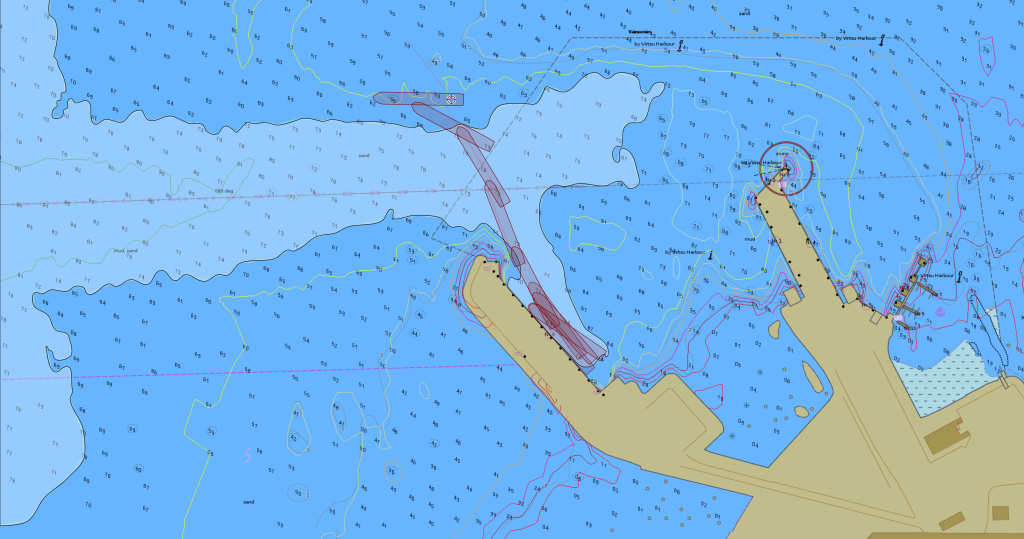
Six minutes after the last mooring line was cast off, at 18:45, the vessel ran aground next to the approach of the Virtsu harbour – approximately 100 m north of the leading lights and approximately 170 m north of the berth No 8 breakwater in coordinates 58° 34,61’ N 023° 30,13’ E.
Since it was not possible to free the vessel from the shallow either by its own power or with the assistance of a pilot boat, the assistance of tug PANDA was ordered. Salvage operation started on May 7 at 04:00 and the vessel was afloat at 06:00. No hull damage or injury to the crew on board were detected and the accident did not cause any environmental damage. During the salvage operation, there was a pilot on board who advised the master to return to the harbour to confirm the vessel's seaworthiness, but the captain's decision was to continue the voyage to the port of Rostock.
Why it happened?
Suggested by the pilot and approved by the master of KETTER, the pilot did not embark the vessel when leaving the harbour, although it was required by the Maritime Safety Act. The pilot explained this decision with the desire to avoid possible overtime, which could have been caused by the departure immediately before the end of the pilot shift. The knowledge, probably recognised in previous practice, that internal control over the actual pilotage, at least in the Väinamere pilotage area, was basically non-existent, may have contributed to reaching such a decision. Human convenience, which was caused by the time required to travel between the mainland and the island where the pilot lived due to the size of the piloting area, might have as well contributed to the decision. The master's decision to agree to leave the harbour without a pilot on-board may have been influenced by the fear of possible delays, which could have led to demurrage at the destination port in Rostock.
When leaving the Virtsu harbour berth in order to reach the leading lights, a sharp turn to port must be made. However, due to late and insufficient manoeuvres, the vessel was carried to the shallow during this turn. The missing pilot's advice, the unfavourable southerly wind and the reduced manoeuvrability of the vessel, which was caused by the shallow water effect (squat) resulting from the minimal under keel clearance of the fully laden vessel, and the limited capacity of the bow thruster contributed to this.
What can be improved?
Pilot service provider (Eesti Loots Limited during the accident, now Estonian State Fleet) is recommended to create and implement measures to ensure that a pilot embarks the vessel, and the pilotage is conducted according to the requirements throughout the whole mandatory pilotage area and to prevent intentional infringement of the requirements and manipulation of the related data.

